
 Discord
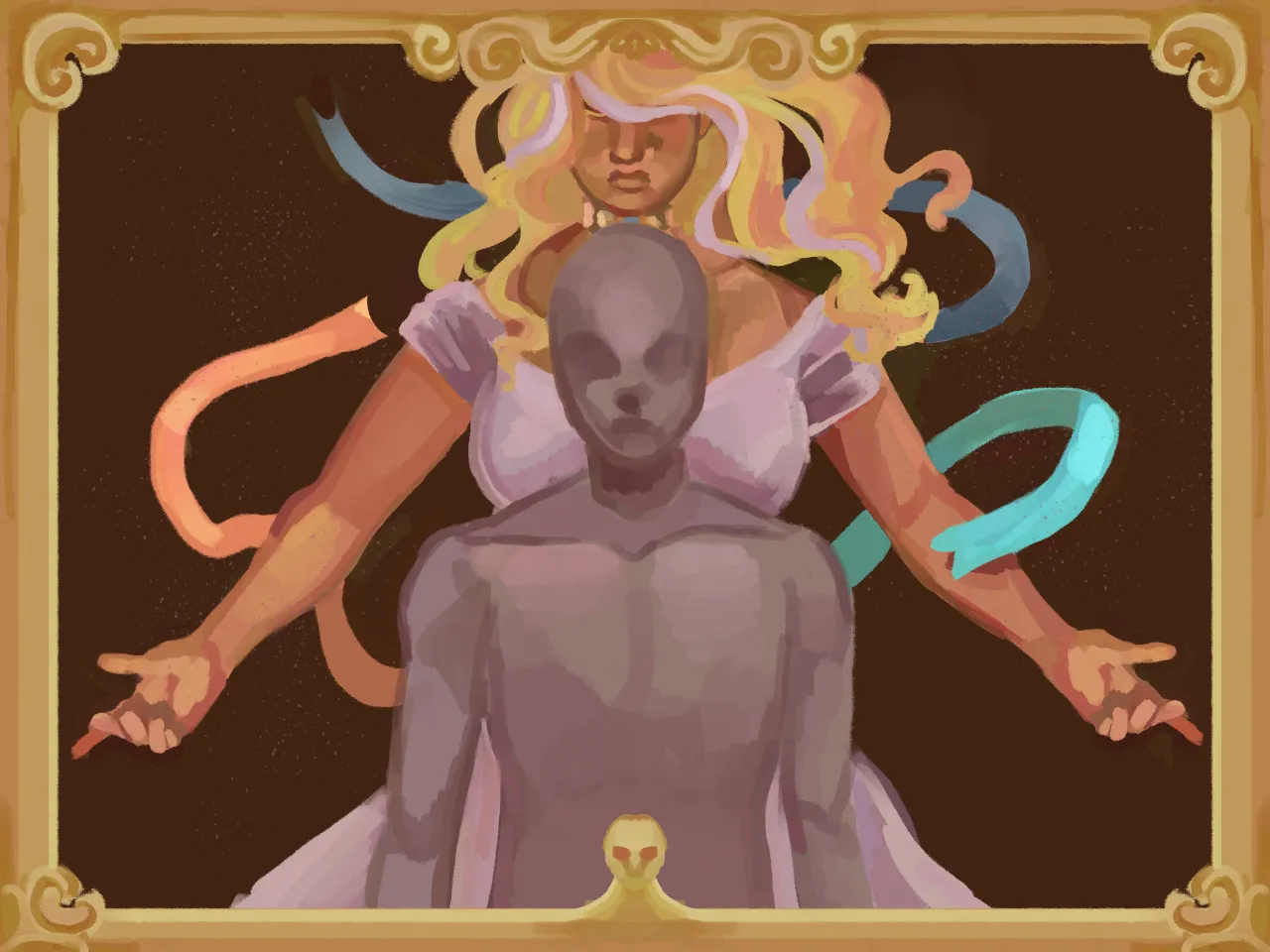
The pair were finally reunited. Isaris had been expecting Sakassen to come crawling back to her since he broke the agreement, and she had not been the least bit surprised to find him crawling back to her castle offering up Lustra. That her sister could not anticipate his treachery confirmed everything she had ever thought about Lustra. The goddess was weak and self-righteous, cowering behind the banner of the law because she had nothing tangible to fight for. Lustra had always thought she was better than Isaris; now, she would know the truth. Isaris spat. She hated having to rely on Sakassen for her plans to come through. Still, now that he was finally cemented on her side, her final plan could finally be put into action. Marlak and Xaophet, mere game pieces in a larger scheme, were dismissed, having already served their purpose. They were unlikely to endorse the dark design Sakassen and Isaris had woven in the shadows.
They made the announcement from the high tower of her castle. Sakassen used the energy from the battleground against Lustra to project the message out to the gods and mortals below.
“From this night and for all future nights, we establish a new era of the gods’ rule over the earth. No longer shall we be beholden to any foolish agreements; from this day, gods may reign free over their domains. As it once had in ancient times, our power shall flow freely again! Our final battle begins at sunrise.”
Such a bold-faced declaration of war was a risk, even for Isaris and Sakassen. It was clear their godly allies would not agree to these new terms. As powerful as they may be, there were only two of them against the Pantheon, and they were already expending energy to keep Lustra imprisoned. Isaris needed to maintain a healthy supply of mortal souls to keep her frozen in her cell.
But then Sakassen offered up his solution. In honor of this new, chaotic era, they would unleash a secret weapon, one even Lustra would not suspect Isaris of attempting to open.
It would all come down to the most unexpected of gods: the loner, Gadolc. At the dawn of days, the gods had faced a terrible foe: the monstrous world that lay outside even their domain. There had been a gate connecting these two worlds, and much of their time was spent protecting the mortal world from the other. Gadolc sealed that gate, and the gods were left to rule over the mortals’ land in peace.
Sakassen meant to open the gate once more.
“How can you be sure we will be able to close it again?” asked Isaris.
“This is not the first time I have thought to use the gate. I’ve opened it before—only a crack—but just enough to allow some of my perversions to slip through. I was curious to see how they would fare in the world of monsters.” Isaris’ eyes flashed. This was reckless, even for Sakassen, and for a moment she wondered if even she had managed to underestimate his potential for chaos. “As soon as I opened the crack, the gate began to seal again. It was Gadolc sealing the fissure. I doubt it even piqued his awareness. His energy will seal the gate when we open it; I am sure of this.”
The hour of the final battle drew near. Atop her spire once again, Varyssa lay on her loveseat with Gadolc at her side. She had tried to work with the other gods, really, she had. But their selfishness won out, so she was left alone with Gadolc, as she often was—alone with the one god who saw the world as she did. And soon, he would have to die. Gadolc's ever-calm demeanor did nothing to ease her worries; instead, it magnified her own turmoil, like the stillness before a storm that only heightened her anxiety.
“Time runs short, Gadolc.”
“You mean to go through with your plan then, to establish an era of retreat from the mortal world.”
“What else can we do? The gods are a menace to the world. We must have nothing else to do with mortals. We have discussed this, Gadolc; don’t you agree?”
“Did you not listen to Ferona?”
“Ferona? I’m surprised you listened to her. She thinks only of herself.”
“And who do you think of, dear Varyssa?”
“Of the mortals, of course! Of the balance of nature, of the distribution of power—”
“And what of your family?”
“My—what?”
“We have always shared a deep bond. In all of my eternity, the one thing I have been most grateful for is our friendship. But my time in this universe is coming to a close. The thought of leaving you alone is the only part of this that pains me.” Varyssa was stunned. She had never once heard Gadolc outwardly express such direct emotion. “The gods are your family, Varyssa, and their needs should matter to you. You heard what Ferona said. Without access to the mortal world, the gods would go mad with boredom. Think of what might happen then, what violence they might resort to over the eons, just for the simple fact of having nothing else to do. You would condemn all of them to an eternity of misery.”
“So what do you suggest we do?”
“There is another option. I have found a way for the gods to leave the mortal world behind, but not entirely.”
From behind Gadolc, a small figure emerged as if from thin air. Varyssa flinched. It was not good manners to summon another god directly into someone's dwelling. The goddess was Fisa.
“She is our solution,” said Gadolc. “A goddess made from a mortal. She exists between our worlds; she is the inventor.”
“Inventor of what, exactly?” asked Varyssa.
“Avatars,” Fisa piped in, her voice sounding incredibly meek after Gadolc’s deep tone. “Terrestrial avatars for us to possess. They will be under the direct influence of their patron god, but mortal, in essence. We’ll be able to maintain control over the mortals, but our efforts will be less direct, our capacity for damage forever limited.”
“Why are you agreeing to this?” asked Varyssa.
“I was once mortal. I understand the mortal’s plight even better than you, Varyssa, though you dance amongst their dreams. This way, I know that what’s left of my family will be safe after this war.”
 Previous chapter